
Guides
Vietnam Visa Run Requirements & Important Tips for Travelers

Extending a stay in Vietnam does not always mean submitting another visa application. In some cases, travelers may consider an alternative approach known as a visa run. Here is what the process involves and important factors to consider.
Why travelers do a Vietnam Visa Run
A visa run involves physically leaving Vietnam and re-entering to reset the permitted duration of stay on a new visa. The process is entirely legal under Vietnamese immigration law, though officers retain the discretion to question or deny re-entry to travelers who conduct frequent back-to-back runs without a clear purpose of stay.
If your 90-day e-visa expires on June 30, you exit Vietnam on June 28, spend a night in Bangkok or cross into Cambodia for a few hours, then re-enter on June 29 with a brand new visa. Your permitted stay resets from the date of re-entry, giving you another full visa period in the country. Land border runs can often be completed within a single day; airport runs are typically done over a weekend
A visa run is often cheaper than applying for a formal visa extension and can be completed within a single day. For travelers with a fixed schedule or tight timeline, it is often the faster and more practical option.
Who is a Vietnam Visa Run for?
In practice, visa runs in Vietnam are most commonly used by travelers who need to continue their stay when their current visa or permitted stay period is ending.
- Travelers entering Vietnam under visa exemption programs who want to stay longer after their permitted period ends
- Holders of a 5-year visa exemption certificate reaching the 180-day stay limit
- E-visa holders whose visa validity has expired and need to leave Vietnam before applying for a new visa
- Foreign nationals staying in Vietnam on business visas approaching expiration
- Expats, remote workers, or foreign nationals waiting for work permits or long-term visa processing
However, visa runs are not suitable in every situation. Travelers making repeated visa runs within a short period may face additional immigration checks when re-entering Vietnam.

Visa run applies to certain cases needing a quick visa renewal.
Which type of Visa Run is right for you?
There are two main ways to do a visa run in Vietnam, via international airports or via land border crossings. Each suits different budgets, locations, and travel preferences.
By Air
Flying out of Vietnam to a neighboring country is preferred by many expats as it saves energy for travel. The best countries to consider for an airport visa run are Cambodia, Thailand, Singapore, Indonesia, and the Philippines.
Vietnam currently has 13 international airports where travelers can exit and re-enter:
|
Airport |
City / Province |
|
Noi Bai International Airport |
Hanoi |
|
Tan Son Nhat International Airport |
Ho Chi Minh City |
|
Da Nang International Airport |
Da Nang |
|
Cam Ranh International Airport |
Nha Trang |
|
Cat Bi International Airport |
Hai Phong |
|
Can Tho International Airport |
Can Tho |
|
Phu Quoc International Airport |
Phu Quoc |
|
Phu Bai International Airport |
Hue |
|
Van Don International Airport |
Quang Ninh |
|
Tho Xuan Airport |
Thanh Hoa |
|
Dong Hoi Airport |
Quang Binh |
|
Phu Cat Airport |
Binh Dinh |
|
Lien Khuong Airport |
Da Lat |
By land border
The land route is favored by long-term expats for its affordability and flexibility. Vietnam has 27 land border gates accepting e-visas, though the most commonly used for visa runs are:
|
Destination |
Border Gate |
Province |
Notes |
|
Cambodia |
Moc Bai |
Tay Ninh |
Most popular from Ho Chi Minh City |
|
Cambodia |
Tinh Bien |
An Giang |
Alternative route for Mekong Delta travelers |
|
Cambodia |
Ha Tien |
Kien Giang |
Southern coastal crossing |
|
Laos |
Lao Bao |
Quang Tri |
Common option in central Vietnam |
|
Laos |
Cau Treo |
Ha Tinh |
Accessible from north-central provinces |
|
Laos |
Cha Lo |
Quang Binh |
Convenient near Phong Nha area |
|
Laos |
Tay Trang |
Dien Bien |
Northern crossing to Laos |
|
China |
Huu Nghi |
Lang Son |
Busiest Vietnam–China crossing |
|
China |
Lao Cai |
Lao Cai |
Popular route toward Yunnan |
*Important: The original visa approval letter with red stamp and signature is required at land border crossings, a copy, scan, or photo is not accepted. Not all border gates allow visa runs, always verify your specific crossing is on the approved list before traveling.
Documents required for a Vietnam Visa Run
To apply for a visa, the following documents are required:
- Original passport valid for at least 6 months from the intended re-entry date and with at least 2 blank pages
- One valid entry document for re-entering Vietnam (unless eligible for visa exemption), such as:
- 5-year Visa Exemption Certificate
- Vietnam e-Visa
- Visa Approval Letter for Visa on Arrival (currently mainly applicable to business visa applicants)
- 2 passport-sized photos (4 × 6 cm, white background, taken within the last 6 months), check photo guide here.
If using a land border crossing, additional prepare:
- Approximately USD 10 cash for border immigration formalities
- Bus tickets or private transportation arrangements
- Vietnam Visa Application Form (NA1 Form), check the form completion guide
- Visa stamping fees are USD 25 for single-entry visas and USD 50 for multiple-entry visas.
How to get a Vietnam Visa Run – Step by step
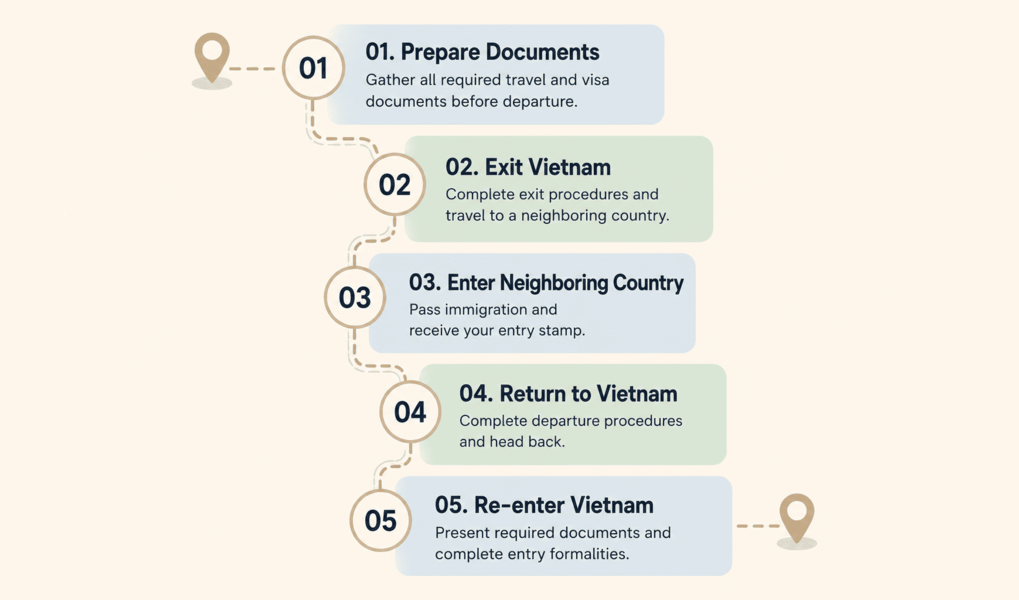
> Step 1: Prepare all required documents
Foreign travelers should prepare all required documents in advance before leaving Vietnam. Missing or incorrect paperwork may result in delays, additional processing time, or entry issues upon returning to Vietnam, so checking all documents carefully before departure is strongly recommended.
Note: If planning a same-day visa run, the visa for the destination country can often be obtained directly at the border crossing or in advance at that country’s embassy in Vietnam.
> Step 2: Exit Vietnam
Depending on your chosen method, complete Vietnam exit formalities at your designated checkpoint, present your passport to the immigration officer and receive your exit stamp. You will then travel to the neighboring country by air or by land.
> Step 3: Enter the Neighboring Country
Upon arriving at the border checkpoint of the destination country, whether an airport or land border gate, present your passport and any required entry documents to complete immigration formalities and receive your entry stamp.
> Step 4: Exit the Neighboring Country
You can return immediately after entering the neighboring country or stay for a few days before heading back. Once ready to return, complete exit formalities at the border checkpoint of the neighboring country and make your way back to the Vietnam border gate.
> Step 5: Re-enter Vietnam and Complete the Visa Run
Upon arriving at the Vietnam border checkpoint, present the following documents:
- Original passport (valid for at least 6 months from the date of re-entry, with at least 2 blank pages)
- One of the following valid entry documents:
- 5-year visa exemption certificate
- Vietnam e-visa
- Visa approval letter
- If collecting a visa stamp at the border, additionally present 2 passport-sized photos (4×6 cm) and a completed Vietnam visa application form
Travelers collecting a visa stamp will have it affixed to their passport at the border counter before proceeding to immigration.
All other travelers proceed directly to the immigration security counter, where the entry stamp and new permitted stay duration will be recorded in the passport. The visa run is now complete and legal residency in Vietnam resumes from the date of re-entry.
Important notes before you go
A visa run is straightforward when properly prepared, but a few common mistakes can derail the entire process:
- Plan early. Arrange your visa run at least 5 to 7 days before your current visa expires.
- Bring original documents. Land border crossings require original paperwork, as copies and digital files are not accepted.
- Check border operating hours. Some land crossings do not operate around the clock.
- Prepare cash in advance. Immigration counters generally do not accept card payments.
- Avoid major holiday periods. Border crossings can become significantly busier during Tet Holiday, Reunification Day, and National Day.
- Avoid repeated visa runs within short periods. Frequent visa runs may lead to additional immigration checks upon re entry.
If you are doing visa runs every few months, it is worth considering whether a business visa, investor visa, or temporary residence card makes more practical and financial sense in the long run. Refer to our Vietnam long-term visa options guide for details.
For assistance preparing your re-entry documents, our team is available 24/7:
- Phone/WhatsApp: (+84) 856 598 868
- Email: info@simplevietnamvisa.com
*Visa requirements and regulations are referenced based on the official guidelines from the Immigration Department of Vietnam
Frequently Asked Questions
A single visa run will not affect re-entry. However, repeated back-to-back runs without a clear purpose of stay may result in additional questioning or denial of entry at immigration.
Your permitted stay resets from the date of re-entry based on the new visa obtained, 90 days for an e-visa, 30 days for a standard single-entry visa on arrival, or up to 3 months for a multiple-entry option.
Yes, particularly via land border. Moc Bai to Cambodia is the most popular same-day option from Ho Chi Minh City, taking approximately 2 hours each way. Airport runs typically require at least one overnight stay.
No. A visa run requires physically leaving Vietnam to re-enter on a new visa. An extension allows you to remain in Vietnam throughout without crossing any border.
